Past Mahi
Since the Community took over the lease of Quarantine Island in 1958, initially as the St Martin Island Community, a huge amount of work has gone into making the island accessible and habitable! Early community members describe: “The climb from the jetty was difficult and overgrown”, “a deep layer of solidified goat dropping had to be dug out of the milking shed” and “the main house (the enlarged Keeper’s Cottage) the only building still in fair condition.” A number of works have been undertaken, the jetty has been extended, the Community built the Chapel, the Lodge has been added to, composting toilets have been installed and a very valuable and essential rainwater collection and storage system has been extended.
The Married Quarters
Saving the ‘Married Quarters,’ New Zealand’s only two-storied wooden quarantine building, which remains on its original site. This is the last remaining building of the 1870′s quarantine station, a prominent two-storied building that once housed families in quarantine. The building had become very dilapidated, when a massive effort was put in to save and restore it, led by former keeper, Kathy Morrison. The building is now weatherproof and structurally sound. In fact, we are delighted to have won an award in 2019 for our collective work to save and preserve this special building!
We gratefully acknowledge major financial contributions to the Married Quarters project from Lotteries Environment and Heritage, the Otago Community Trust, Perpetual Trustees Charitable Trust, Dunedin Heritage Fund, Alexander Mc Millan Trust, and Sargood Trust and the many others giving generously in both cash and kind. Our former and current Keepers, especially Kathy Morrison, but also Graeme Furness, Francine Vella, Don Hunter, Phil Perrow and Dries van den Broeck; the Department of Conservation; Heritage NZ; Phil Ballard (Fire Engineer); Graeme Innes (electrician); Chubb; Thankyou Charitable Trust; Otago Peninsula Community Board; Chalmers Community Board; West Harbour Lions; Dunedin Casino; Tracey (T.C.) Elliott; Zena Bracey; Kristen Bracey & Chris Brown; Port Otago; Southern Clams; John McLachlan; Resenes; Bramwells; South Bar; and the Dunedin Zen group.
Our builder/painter/project manager since 2015, Paul Clements, has been so resourceful and generous, enabling us to complete this ambitious project. Finally, we would like to thank the many volunteers who cheerfully helped at working bees, and our special Heritage Open Days, and who have made the whole daunting undertaking, do-able and enjoyable! Thanks to Alexander McMillan Trust and Otago Community Trust for funds to repaint the exterior in March-April 2019, and Paul Clements and Moana House for doing this work. To find out more about what was found during the archaeological monitoring of the excavation, read Shar Briden’s report.
Access to the Buildings from the Jetty
When the Community first arrived on the island they had to scramble their way through the bush up a steep hill to the historic buildings. In the early years, the Community cleared a path from the jetty up the side of the hill to the ‘Lodge’ (old Keepers cottage from quarantine days). This track still exists and is the most used access way. It does get very muddy in the winter and is very vulnerable to slipping being steep with patchy ground cover.
It was decided that another access was needed making the route to the historic buildings a little easier. Steps were cut and built from the jetty up to the current Keeper’s Cottage (originally the WW1 soldiers recreation rooms). Thanks to the Bendigo Valley Sports and Charity Foundation, Dunedin Amenities Society and the Bracey-Brown family for generous financial help with this. Major repairs were done to the jetty by Port Otago in 2019 which enabled QIKTC to meet the Otago Regional Council’s WOF requirements. Access ladders were donated by John McLachlan and Port Otago.
Water Storage
We are dependent on catching and storing rainwater on the island. Until recently we were reliant on storing all our water in the original concrete tanks, which have cracks and leaks. With increasing long dry periods, which will become more common due to climate change, we have tried to increase water storage. In 2010, The Sargood Bequest donated funds for a 30,000 litre tank, which was transported to the Island by helicopter, thanks to a grant from the Bendigo Valley Sport & Charitable Foundation. Volunteers carried over all the gravel and built the pad. Thanks particularly to Chris Brown for doing this work.
Thanks to the Speights Fund in 2018 we were able to purchase a new 3,500 litre tank, pipes and fittings, to further reduce dependence on the aging concrete tanks. A new UV water treatment system was installed, with the help of a DCC Services Grant in 2017. In 2019, Jess Penwarden ran a givealittle campaign to raise funds for another tank. The Otago Community Trust (OCT) donated funds for the balance and in mid-2021 a new 25,000 litre tank will add significant new storage. Volunteer Graham Innes spent many hours upgrading a second-hand pump, purchased through the OCT grant, so that we can pump water around the system to maximise water capture and storage.
Lodge and Cottage Maintenance
The WW1 soldiers’ recreation rooms have been added to and transformed into the current resident Keepers Cottage. Extensive fencing has been erected to protect the regenerating native bush and provide a space for farm animals. Huge amounts of volunteer work have gone into creating the beautiful, interesting and refreshing sanctuary that Quarantine Island Kamau Taurua is to so many people.
For many years, the Keeper’s cottage had no fireplace, hot running water, nor washing machine, and the toilet was a long-drop adjacent to the cottage. Kathy Morrison, the Island’s Keeper for 12 years, and her partner Douglas Black and teenage daughter, Bryony, did it tough! A wood burner was installed just as Kathy left, and it was Graeme Furness, the subsequent Keeper who got to enjoy this. A small composting toilet was installed during Graeme’s time and a hot water cylinder for the cottage. Graeme installed a sink to the back bedroom and made this space available to QIKTC members for casual use. The addition of a washing machine during Francine Vella’s time as Keeper meant dirty washing no longer needed to be taken off the island!
When Anna Hughes and Wayne Johnson moved on to the Island with their two young boys, Eli and Niwha, in 2013, the Community Council tried hard to fundraise in order to make the cottage warmer. Underfloor insulation was installed, the rotting southern wall was repaired, and a rotten window replaced. A big thank you to Peter Matheson, Kristen Bracey and Chris Brown for generous donations to enable this. Good curtains for the lounge and dining room were bought from the Dunedin Curtain Bank.
Subsequent Keepers and the Council chipped away at small improvements and maintenance. Dries van den Broeck built new shelves in the kitchen, experimented with a urine separator in the composting toilet, and freshened up the paint in the lounge. Paul Clements was employed to replace some of the rotten windows and weatherboards, with Dries’ capable assistance, and volunteers helped with painting the exterior and improving the spouting. A lot of work has also taken place to improve the Lodge over the years. As funds and energy allow, we continue to work on this. Composting toilets, which have a batch system, were installed in the 1990s.
Graeme Furness made the beautiful benches in the Lodge kitchen. Builder Matt King built the ‘boot room’, installing the large window which gives us a wonderful view towards Portobello and of the Little Shags which nest in the macrocarpas below. Prior to Matt’s work to create this room, this area was not enclosed, and dark and grotty. Matt was wonderful at including and upskilling volunteers to ‘help’ him, including the teenagers. Chris Brown and Kristen Bracey donated funds for wool insulation above the lounge and dining room, and the Council supplemented this with batts. Thanks to Chris Brown also for jibbing the bunkroom and patching gaps in the ceiling and floors. The discovery of some old newspaper lining on the bunkroom wall revealed interesting news from 1898, which has been protected. You’ll have to visit to find out the good news!
In December 2016, a Panasonic heatpump was installed in the Lodge Dining Room, thanks to a generous $3000 grant from Foodstuffs/Gardens New World, and a $600 discount from Panasonic. In 2017- 2018 volunteer electricians Roman Solomatenko and Graham Innes donated more than 100 hours to replace and upgrade most of the electrical system in the Lodge and make some improvements in the cottage. Thanks to a DCC Services Grant in 2017 for covering materials. Thanks also to this fund for enabling us to purchase a UV water filter so we can treat the drinking water.
Donations from the Sargood Bequest and QIKTC funds enabled us to replace most of the mattresses with wipeable PVC covered ones. A grant from the Otago Community Trust, QIKTC funds and local plumber Richard Gees‘ donation of his skills, meant we were able to replace the aged water cylinder in 2021. The Otago Peninsula Community Board and OCT co-funded new smoke alarms. Keeper, Dries van den Broek replaced rotten weatherboards and enclosed the south wall of the Lodge in 2020, to make the lounge warmer. Paul Clements was employed again to remove rotten wall framing and weatherboards.
Of course, many volunteers have also helped preparing and painting the roof, the exterior and interior walls, ceilings; scrubbed and varnished the wooden floor in the toilets; and spent time repairing things. We know that volunteers have jobs like this to do in their own homes so we are very appreciative of them giving up their time to help with these things on the island.
Seats and picnic tables
Thanks to donations, notably from Lyndall Hancock, Zena Bracey, the Dunedin Amenities, and Grant Bracey-Brown, there are picnic tables and seating around the buildings, and in special spots throughout the reserve. They are there to encourage visitors to pause, to enjoy the wonderful, ever-changing views, to sit and chat or take time for themselves. One of the seats is particularly special, ‘Lyndall’s Lookout’, just below the ridge overlooking the cemetery and with views in all directions. This was designed by Community members, built by Paul Clements with assistance from Keeper Meghan Hughes, in honour of our oldest active volunteer/member, Lyndall Hancock, who joined the Community in about 1960, and in 2021 turned 91.
Survey of the Island and Cemetery
In August 2016, Dr Pascal Sirguey and Craig McDonnell from the University of Otago School of Surveying conducted a survey of the Island using a combination of photos captured by a Remotely Piloted Aircraft System (RPAS, a.k.a., drone or UAV) and ground survey. This gives us up to date topographical data and aerial imagery of the island at unprecedented resolution and will add to the understanding of the ecology and heritage features on the Island. A further ground survey of the cemetery took place in early 2017.
Predator Control and Biodiversity Monitoring
The Island has introduced rats (Norway) and mice. These affect biodiversity, eating seeds, insects, bird eggs and fledglings, and skinks. We have been using traps to reduce numbers of rats and mice from Winter 2016. We monitor biodiversity over time to see the impact of trapping and efficacy of the traps. The Island is a haven for natural biodiversity in Otago Harbour. The QIKTC is part of Predator Free Dunedin. The only mammalian pests on the island currently are Norway rats and mice, but the island is close to the mainland on both sides of the harbour, so there is an ongoing risk of invasion of other pests. QIKTC have no evidence of mice on the island prior to 2010. Did they arrive as stowaways on a boat or in someone’s bag?
Rats and mice are mainly controlled with 31 goodnature* A24s, first installed in August 2016, 6 DOC 200s (a snap trap particularly for rats), installed with the Halo Project in October 2017, and some snap traps for mice. The A24s have been modified by goodnature* to make them more effective for mice control ( they are normally designed for rats and stoats). The difficult Island terrain is why these traps were chosen; they automatically reset so do not need frequent checking and resetting. They are also humane.
We record casual sightings of carcasses as part of monitoring the efficacy of the traps. Carcasses can be scavenged so there is not always evidence that a rat or mouse has been killed. In 2018, when there was very active monitoring as part of our citizen science ‘Curious Minds’ project, 30 rat carcasses and 100 mice were recorded. In 2019 there were 19 rat carcasses and 38 mice. In 2020 to July 5, 1 rat and 6 mice. Of the total 50 rats recorded, 37 were found in the traps by the buildings; of the 144 mice recorded, 64 were from around the buildings. A motion-sensitive camera is used occasionally and has captured footage of rats looking at the traps and tracking tunnels, but not entering.
Inked tracking cards are put out in tunnels around the Island on a regular basis, to monitor predator activity. Prints on the tracking cards to-date are of mice, apart from possible rat prints on two heavily printed cards in February 2018. Mice prints on an overnight survey in July 2020 showed mice tracks on 64% of cards, compared to 37% of cards in a survey in July 2018. Mice are notoriously difficult to control – they breed rapidly and have a small home range. What is the consequence of not controlling mice? Predator NZ shares interesting research about this here.
Thanks to the DCC’s Biodiversity Fund, Otago Peninsula Community Board and the Dunedin Amenities Society for funding the A24 traps, and the Halo Project for the DOC 200s. Thanks also to Curious Minds and the Otago Participatory Science Fund, and scientists; Dr Jillian Hetherington, Clare Cross, Sam Haultain, Derek Onley, Dr Barbara Anderson, James Tweed, and Aishwarya Muralidhar, who helped us explore ways to monitor biodiversity and the efficacy of the traps.
Article in the ODT Saturday, 6 March 2010 - “Hard work restoring history of Quarantine” By Rebecca Fox
Restoring a historic building on an island in the middle of Otago Harbour is no mean feat, says former Quarantine Island caretaker Kathy Morrison. To start with, there were 13,000kg of building supplies and scaffolding to be transferred from the jetty up the hill to the building site and a helicopter will be needed to fly in the restored and glazed windows. Ms Morrison said the restoration was made harder by the building's location, but seeing the progress of the restoration on the historic accommodation block made it all worth it.
"It's very exciting." The St Martin Island Community, which owns the buildings on the island, had made the decision to save the block, constructed in 1873 to house healthy married couples until they were cleared to enter Dunedin. "We had to decide to either pull it down, as it was unsafe, or save it." The aim was to restore the building, which was a part of the city's history. It could possibly be used as a hall when finished, she said.
A former caretaker started the job by putting in wires to reinforce it and about seven years ago, Ms Morrison, with help, rebuilt the southeast wall. Funding had been received through the Lottery Environment and Heritage Fund and the Otago Community Trust. Individuals and businesses had also given their support. An example was South Bar, whose staff had volunteered their time to carry supplies up to the building site, she said. The Dunedin bar was among organisations which used the facilities on the island.
The Lottery fund put $39,500 towards the roof work and the Otago Chamber of Commerce $13,000 towards the restoration of the ventilation shafts. Another grant, of $168,000, was received from the Lottery fund for the work to fix the walls. Recently, the roof was replaced, including its ventilation shafts, and work began this week on restoring the walls. "It'll make it weatherproof for the first time." The boards would be stripped back and what could be saved would be wetted and pressed, to flatten them out. They would then be put back.
Window frames would also be taken to Dunedin for restoration and then helicoptered back to the island, she said. "We are trying to save as much of the existing material as possible." Once that stage was completed, the St Martin Island Community would start looking for funding to restore the floor. The work was being overseen by project engineer Guy Williams. Naylor Love was doing the work, with help from the St Martins community and others associated with the island.
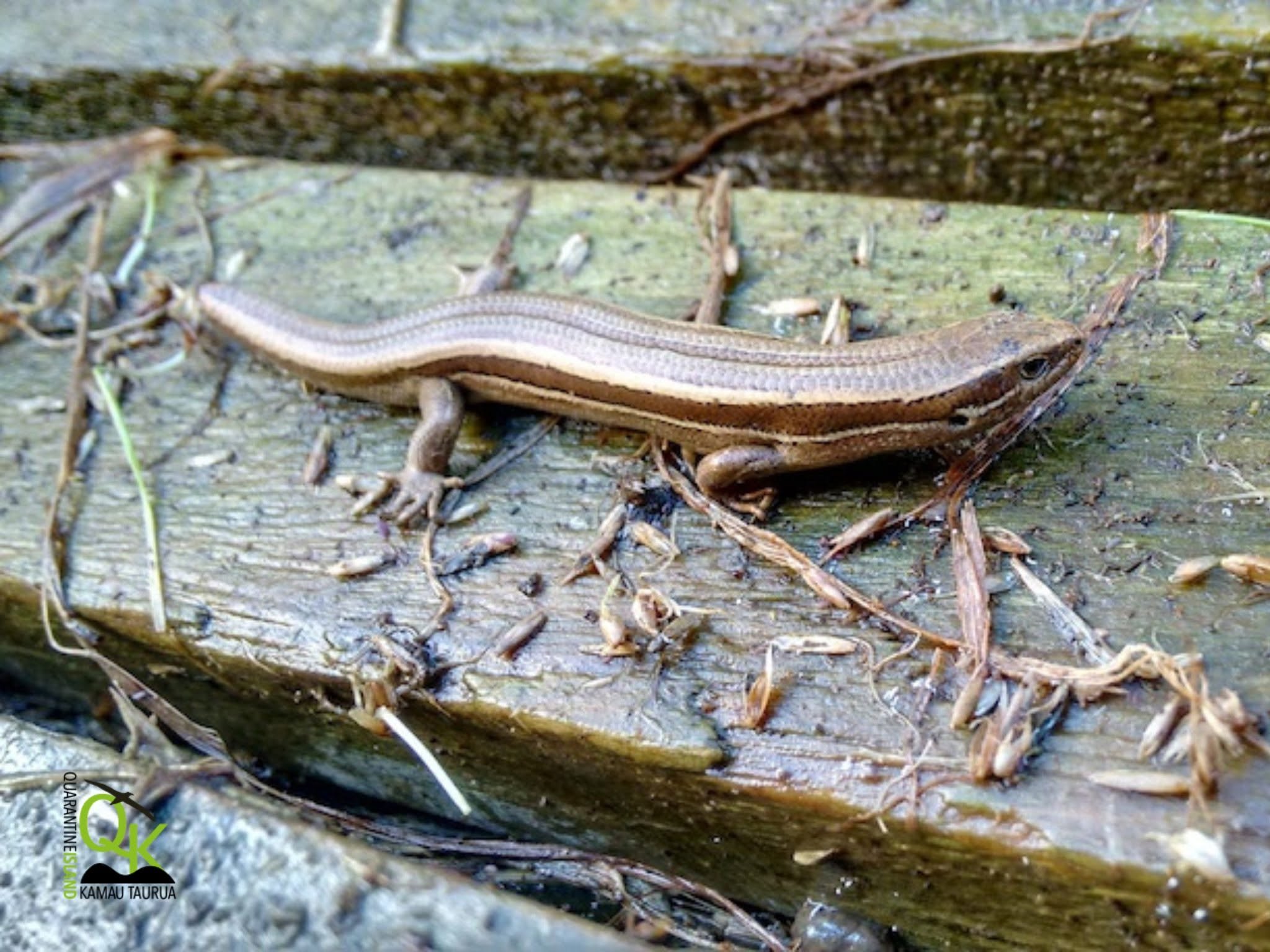
Southern Grass Skink photo from 2017 - photo by Sam Haultein. Southern Grass Skinks or Mokomoko are an endemic lizard that only live around the damp areas of Canterbury, Otago, and Southland. On sunny days, you might see them warming themselves on the rocks around the motu.
Starting in 2017, we started monitoring the skinks around the island to understand what kinds and how many lizards are living on the island and to see how effective conservation actions are on their population. We've also been planting native shrubs like Tororaro and Porcupine Bush to provide food for these little guys.